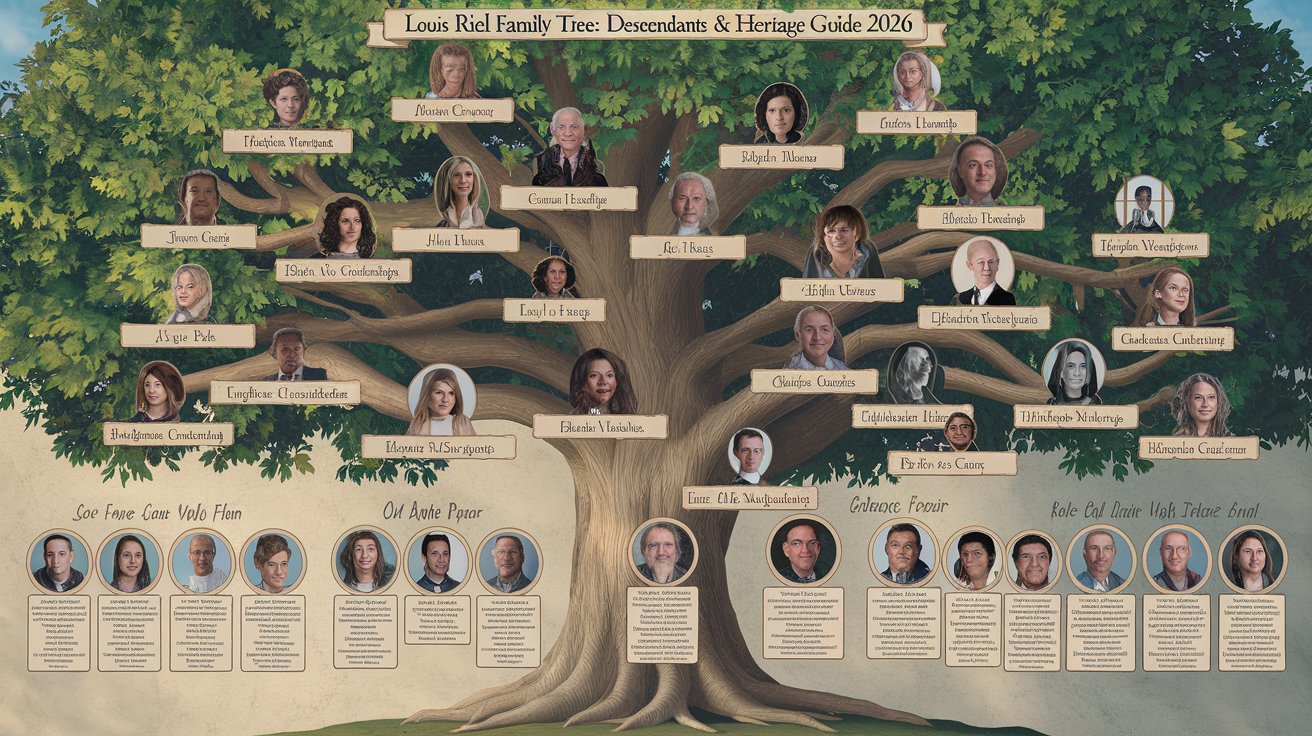
The Louis Riel family tree represents a significant lineage in Canadian and North American Métis history. Louis Riel, born October 22, 1844, descended from a prominent Métis family in the Red River Settlement. His ancestry combined French-Canadian and Indigenous roots, creating a unique heritage that shaped his role as a political leader. Understanding Riel’s genealogy provides insight into the cultural foundations of the Métis Nation and the complex family relationships that influenced his historic actions during the 1869 and 1885 Métis resistance movements.
Louis Riel’s Parents and Early Family Origins
The Riel family ancestry traces back to Jean-Baptiste Riel dit l’Irlande and Marguerite Boucher, who settled in New France during the early colonial period. Louis Riel’s father, Jean-Louis Riel, was born in 1817 in Île-à-la-Crosse and became a prominent Métis leader in the Red River Settlement. Jean-Louis married Julie Lagimodière in 1844, establishing the immediate family from which Louis Riel emerged. Julie Lagimodière was the daughter of Jean-Baptiste Lagimodière and Marie-Anne Gaboury, making her one of the first European women to settle in western Canada.
The Lagimodière side of Louis Riel’s family tree brought significant French-Canadian heritage, while the Riel paternal line carried both French and Ojibwe ancestry. This blended heritage positioned the family within the Métis community as cultural bridge-builders. Jean-Louis Riel gained respect as a miller and community advocate, leading resistance against the Hudson’s Bay Company’s monopoly in 1849. This activism established a family tradition that Louis Riel would later continue, demonstrating how family influence shaped his political consciousness and commitment to Métis rights throughout his life.
Louis Riel’s Siblings and Extended Family Network
Louis Riel was the eldest of eleven children born to Jean-Louis and Julie Riel between 1844 and 1864. His siblings included Sara Riel, who became a Grey Nun and educator; Octavie Riel; Joseph Riel; Eulalie Riel; Henriette Riel; Charles Riel; Alexandre Riel; Philomène Riel; Joseph Riel Jr.; and Marie Riel. The Riel family experienced significant hardship, with several children dying young due to the harsh conditions of frontier life in the Red River Settlement during the mid-19th century.
Sara Riel, born in 1848, became particularly notable within the family lineage. She joined the Grey Nuns religious order and dedicated her life to education, establishing schools for Métis and Indigenous children in Manitoba. Her work preserved aspects of Métis culture and language that might otherwise have been lost. The extended Riel family network included connections to other prominent Métis families such as the Lépines, Schmidts, and Naults, creating a web of kinship relations that strengthened community bonds and political alliances during critical periods of resistance against colonial expansion in western Canada.
Louis Riel’s Wife and Marriage
Louis Riel’s wife was Marguerite Monet dit Bellehumeur, whom he married on April 28, 1881, in Carroll, Montana. Marguerite was born in 1861 to Jean-Baptiste Monet and Julie Lépine, making her significantly younger than Riel, who was 36 at the time of their marriage. The couple met while Riel was living in exile in Montana following the Red River Resistance of 1869-1870. Their marriage occurred during a period when Riel was working as a teacher and trader, attempting to build a stable life away from political turmoil.
The marriage of Louis Riel brought together two established Métis families and represented the continuation of traditional kinship patterns. Marguerite came from a family with deep roots in the Red River Settlement, strengthening Riel’s connections to the Métis community despite his exile. The couple’s relationship endured through extremely difficult circumstances, including Riel’s return to Canada in 1884, his leadership of the Northwest Resistance in 1885, his subsequent arrest, trial, and execution. Marguerite supported her husband throughout these trials, demonstrating the strength of their family bond during one of the most turbulent periods in Canadian history.
Louis Riel’s Children and Direct Descendants
Louis Riel children numbered three: Jean-Louis Riel, Marie-Angélique Riel, and a third child who died in infancy. Jean-Louis, born September 1882 in Montana, was named after his grandfather. Marie-Angélique, born May 1883 in Montana, carried forward the family name. The Riel children were very young when their father was executed on November 16, 1885, leaving them with limited memories of him. Jean-Louis was only three years old, and Marie-Angélique was just two when they lost their father to the gallows at Regina.
After Louis Riel’s execution, Marguerite faced severe financial hardship raising the children alone. The Canadian government provided no support or compensation to the family, despite Riel’s significant role in bringing Manitoba into Confederation. Jean-Louis and Marie-Angélique grew up bearing the weight of their father’s controversial legacy. Historical records indicate that Jean-Louis Riel lived into the 20th century but maintained a relatively low profile, likely due to the stigma attached to the Riel name during that era. Marie-Angélique similarly lived a quiet life, and both children eventually had families of their own, continuing the Riel bloodline into subsequent generations.
Are There Any Living Descendants of Louis Riel Today?
The question of whether there are living descendants of Louis Riel remains a topic of genealogical interest as of 2026. Based on current genealogical research and records available through platforms like WikiTree and Ancestry, there are confirmed descendants of Louis Riel living today, primarily through his son Jean-Louis Riel and daughter Marie-Angélique Riel. These descendants have maintained varying degrees of connection to their famous ancestor’s legacy, with some actively participating in Métis cultural events and historical commemorations.
The Riel descendants today represent multiple generations removed from Louis Riel himself. Many have intermarried with other families, creating complex genealogical networks throughout Canada and the United States. Some descendants have chosen to publicly acknowledge their connection to Louis Riel, particularly as his historical reputation has evolved from controversial rebel to recognized founder of Manitoba and defender of Métis rights. Research conducted by Métis genealogical societies in 2025-2026 has documented several family lines tracing back to Jean-Louis Riel and Marie-Angélique, though exact numbers remain difficult to verify due to privacy considerations and incomplete historical records from the late 19th and early 20th centuries.
Louis Riel’s Métis Ethnicity and Cultural Heritage
Understanding what ethnicity was Louis Riel requires examining the unique Métis identity that emerged in western Canada during the 18th and 19th centuries. Louis Riel was Métis, a distinct cultural and ethnic group formed through the union of First Nations women and European fur traders, primarily French-Canadian voyageurs. The Métis people developed their own language (Michif), culture, traditions, and political consciousness, distinguishing themselves from both their Indigenous and European ancestors.
The Riel family ethnicity specifically combined French-Canadian heritage from the paternal Riel line and Ojibwe (Anishinaabe) ancestry from his great-grandmother on his father’s side. On his mother’s side, Riel inherited French-Canadian heritage from the Lagimodière family. This blended ancestry was typical of Métis families in the Red River Settlement and formed the basis of a unique cultural identity that Riel would champion throughout his life. The Métis Nation that Riel led represented thousands of families with similar mixed heritage, creating a distinct population with claims to land rights and political autonomy in what would become western Canada.
Who Is Louis Riel Survived By: Family After His Execution
When examining who is Louis Riel survived by, historical records indicate he left behind his wife Marguerite Monet dit Bellehumeur and their two young children, Jean-Louis and Marie-Angélique. Additionally, several of his siblings were still living at the time of his execution in 1885, including his sister Sara Riel, the Grey Nun who continued her educational mission in Manitoba. His mother, Julie Lagimodière Riel, also survived him and lived with the grief of losing her eldest son to political execution.
The family members who survived Louis Riel faced significant challenges in the aftermath of his death. His widow Marguerite struggled financially, as the Canadian government offered no pension or support to the family. The Riel children grew up with the burden of their father’s controversial legacy during a period when Métis people faced increasing marginalization and discrimination. Sara Riel continued her religious and educational work, becoming one of the few family members to maintain public prominence. The broader Riel family network, including numerous cousins, nieces, and nephews throughout the Métis community, also survived and worked to preserve their cultural heritage despite government policies aimed at assimilation throughout the late 19th and early 20th centuries.
What Did Louis Riel Say Before He Died: Final Words
The question of what did Louis Riel say before he died has been documented by witnesses present at his execution on November 16, 1885, in Regina, Northwest Territories. According to historical accounts, Riel’s final words were prayers in French, reflecting his deep Catholic faith despite his complex spiritual journey that included brief periods where he saw himself as a religious prophet. He reportedly said prayers for those present, forgave his enemies, and commended his soul to God.
More specifically, witnesses recorded that Louis Riel’s last statement included the words “Seigneur, ayez pitié de moi” (Lord, have mercy on me) and references to the Virgin Mary. He declined to wear a hood and faced his executioners with apparent calmness. His spiritual advisor, Father André, was present and later testified to Riel’s composed demeanor and religious devotion in his final moments. These final words of Louis Riel have become part of his historical legacy, demonstrating how his faith remained central to his identity even as he faced death for his political actions. The dignity he displayed during his execution contributed to his eventual transformation from executed rebel to recognized founder of Manitoba and defender of Métis rights in Canadian historical memory.
Louis Riel WikiTree and Genealogical Resources
The Louis Riel WikiTree profile serves as a collaborative genealogical resource for researchers investigating the Riel family ancestry. WikiTree is a free, shared family tree where genealogists contribute verified information about historical figures and their descendants. The Riel family tree on WikiTree includes documented connections between Louis Riel and his ancestors, siblings, wife, children, and extended family members, providing a comprehensive view of his genealogical network.
As of 2026, the WikiTree Louis Riel profile includes over 200 documented family connections and continues to grow as researchers add newly discovered relationships and verify existing information. The platform allows users to view Riel’s ancestry going back several generations to his French and Indigenous forebears, as well as forward to his modern descendants. Other genealogical resources for researching the Riel family include Library and Archives Canada, which houses the Riel family papers; the Manitoba Provincial Archives; the Gabriel Dumont Institute; and various Métis genealogical databases maintained by provincial Métis organizations. These resources collectively enable researchers and descendant seekers to trace their potential connections to Louis Riel’s family tree with increasing accuracy and detail.
The Lagimodière Connection in Riel’s Family Tree
The Lagimodière family represents a crucial branch of Louis Riel’s maternal ancestry, contributing significant French-Canadian heritage to his genealogy. Jean-Baptiste Lagimodière and Marie-Anne Gaboury were Riel’s maternal grandparents, and their journey to western Canada in 1806 made them among the first European settlers in what would become Manitoba. Marie-Anne Gaboury holds particular historical significance as the first woman of European descent to settle in the western interior, making her a pioneering figure independent of her connection to Louis Riel.
The Lagimodière lineage brought respectability and established connections to Louis Riel’s family. Jean-Baptiste worked as a voyageur and freeman, gaining respect within both the fur trade economy and the emerging Métis community. The family’s daughter, Julie Lagimodière, became Louis Riel’s mother, creating the direct maternal link. Through the Lagimodière family connection, Riel inherited stories of frontier resilience, Catholic faith, and adaptation to life in the western territories. This maternal heritage complemented his paternal Métis roots, providing him with cultural fluency in both French-Canadian and Métis contexts. Modern descendants researching their connection to Louis Riel often find their genealogical path runs through the Lagimodière line, making this branch particularly important for those conducting family history research.
Riel Family Legacy in Modern Métis Culture
The Riel family legacy extends far beyond genealogy, shaping modern Métis cultural identity and political consciousness in Canada and the United States. The Riel name has become synonymous with Métis resistance, cultural preservation, and the struggle for Indigenous rights. Numerous institutions, schools, parks, and cultural centers bear the Riel name, honoring both Louis Riel’s specific contributions and the broader family’s role in Métis history. As of 2026, the Louis Riel Institute in Manitoba continues to provide educational programming focused on Métis culture and history.
Modern Métis organizations throughout North America reference Louis Riel as a foundational figure in their political and cultural advocacy. The Manitoba Métis Federation, Métis Nation of Ontario, and other provincial organizations invoke Riel’s legacy when asserting land rights, pursuing self-governance, and preserving Métis language and traditions. The Riel family’s contribution to Métis nationhood includes not only Louis Riel’s political leadership but also Sara Riel’s educational work and the extended family’s participation in community building. For descendants and cultural members alike, the Riel family tree represents a living connection to a pivotal period in North American history when Indigenous peoples actively shaped the political landscape of emerging nations, even as colonial forces worked to suppress their autonomy and rights.
Researching Your Connection to Louis Riel’s Family
For individuals interested in researching whether they have a connection to the Louis Riel family tree, several methodological approaches can yield results. Beginning with known family genealogy, researchers should document ancestors from the Red River Settlement, Manitoba, or surrounding regions during the 19th century. Métis individuals with roots in these areas may discover connections to the extended Riel family network through collateral lines even if they don’t descend directly from Louis Riel himself.
Primary resources for Riel family research include the scrip records held by Library and Archives Canada, which document Métis individuals who received land or money scrip under various government programs. The Hudson’s Bay Company Archives contain employment records, census data, and correspondence that mention Riel family members. Church records from Red River Settlement parishes, particularly those of Saint-Boniface Cathedral, document baptisms, marriages, and deaths within the Riel family and their extended kinship network. DNA testing through companies like AncestryDNA or 23andMe can potentially identify genetic connections to Riel descendants, though interpreting these results requires genealogical documentation to confirm specific relationships. Joining Métis genealogical societies and connecting with organizations like the Gabriel Dumont Institute provides access to expert researchers and databases specifically focused on Métis family trees and historical connections.
Related video about louis riel family tree
This video complements the article information with a practical visual demonstration.
Questions & Answers
Are there any living descendants of Louis Riel in 2026?
Yes, there are confirmed living descendants of Louis Riel as of 2026, primarily through his two children who survived to adulthood: Jean-Louis Riel and Marie-Angélique Riel. These descendants represent multiple generations removed from Louis Riel himself and are spread across Canada and the United States. While exact numbers are difficult to verify due to privacy considerations and complex intermarriage patterns, genealogical research by Métis organizations has documented several family lines continuing from Riel’s children. Some descendants actively participate in Métis cultural events and historical commemorations, while others maintain private lives away from the public attention associated with their famous ancestor.
Who were Louis Riel’s wife and children?
Louis Riel’s wife was Marguerite Monet dit Bellehumeur, whom he married on April 28, 1881, in Montana. The couple had three children: Jean-Louis Riel (born September 1882), Marie-Angélique Riel (born May 1883), and a third child who died in infancy. Jean-Louis and Marie-Angélique were very young when their father was executed in November 1885, with Jean-Louis being only three years old and Marie-Angélique just two. After Riel’s execution, Marguerite faced significant financial hardship raising the children without government support, and both children grew up bearing the weight of their father’s controversial legacy during a period of intense discrimination against Métis people.
What ethnicity was Louis Riel?
Louis Riel was Métis, a distinct ethnic and cultural group that emerged from unions between First Nations women and European fur traders in western Canada. Specifically, Riel’s ethnicity combined French-Canadian heritage from both his paternal Riel line and maternal Lagimodière line, along with Ojibwe (Anishinaabe) ancestry from his great-grandmother on his father’s side. This blended heritage was typical of Métis families in the Red River Settlement and formed the basis of a unique cultural identity. The Métis people developed their own language (Michif), customs, traditions, and political consciousness, distinguishing themselves as a nation separate from both their Indigenous and European ancestors. Riel championed this distinct Métis identity throughout his political career.
What did Louis Riel say before he died?
According to witnesses present at his execution on November 16, 1885, Louis Riel’s final words were prayers in French, reflecting his deep Catholic faith. He reportedly said “Seigneur, ayez pitié de moi” (Lord, have mercy on me) and made references to the Virgin Mary. Riel declined to wear a hood and faced his executioners with apparent calmness. He prayed for those present, forgave his enemies, and commended his soul to God. His spiritual advisor, Father André, testified to Riel’s composed demeanor and religious devotion in his final moments. These last words demonstrated that his Catholic faith remained central to his identity even as he faced execution for his political actions, contributing to his eventual transformation in historical memory from executed rebel to recognized founder of Manitoba.
How can I research my connection to Louis Riel’s family tree?
To research potential connections to the Louis Riel family tree, start by documenting your known ancestors from the Red River Settlement, Manitoba, or surrounding regions during the 19th century. Key resources include Library and Archives Canada’s scrip records documenting Métis individuals, Hudson’s Bay Company Archives with employment and census data, and church records from Saint-Boniface Cathedral parishes. The Louis Riel WikiTree profile provides a collaborative genealogical resource with over 200 documented family connections. DNA testing through services like AncestryDNA can identify genetic connections, though genealogical documentation is essential to confirm specific relationships. Joining Métis genealogical societies and connecting with organizations like the Gabriel Dumont Institute provides access to expert researchers and specialized databases focused on Métis family trees and historical connections to the Riel family network.
Who was Sara Riel and how was she connected to Louis Riel?
Sara Riel was Louis Riel’s younger sister, born in 1848 as one of eleven children of Jean-Louis and Julie Riel. She became a Grey Nun and dedicated her life to education, establishing schools for Métis and Indigenous children in Manitoba. Sara survived her brother’s execution in 1885 and continued her educational mission for many years afterward, becoming one of the few Riel family members to maintain public prominence. Her work preserved aspects of Métis culture and language that might otherwise have been lost during a period of intense government pressure for assimilation. Sara Riel’s legacy as an educator and religious figure complemented her brother’s political activism, demonstrating the Riel family’s multifaceted contributions to Métis community development and cultural preservation throughout the late 19th and early 20th centuries.
| Family Tree Aspect | Key Details | Historical Significance |
|---|---|---|
| Parents | Jean-Louis Riel and Julie Lagimodière, married 1844 | Combined French-Canadian and Métis heritage, established activist tradition |
| Siblings | 11 children including Sara Riel (Grey Nun educator) | Extended family network strengthened Métis community bonds |
| Wife | Marguerite Monet dit Bellehumeur, married 1881 | Provided support through exile, resistance, and execution |
| Children | Jean-Louis (b.1882), Marie-Angélique (b.1883) | Continued the Riel bloodline through multiple generations |
| Living Descendants | Confirmed descendants exist as of 2026 | Maintain connection to Métis heritage and Riel legacy |
| Ethnicity | Métis (French-Canadian and Ojibwe ancestry) | Represented distinct Métis Nation identity and political rights |
| Research Resources | WikiTree, Library and Archives Canada, Métis genealogical societies | Enable descendants and researchers to trace family connections |